
Felix Schwarz · 13 October 2026
Gdansk Sensor Networks Shape Traffic Pilots in Baltic Port Cities
Traffic sensors installed across Gdansk have captured detailed flow patterns at port entrances, roundabouts, and arterial routes, and those datasets now inform pilot programs in other Baltic port cities. Researchers at urban planning institutes compiled multi-year records showing peak freight movements between 6 a.m. and 10 a.m. on weekdays, with secondary surges after 4 p.m. that align with passenger vessel arrivals. The patterns reveal consistent bottlenecks at specific junctions where container trucks intersect commuter traffic, prompting authorities in Riga and Tallinn to test adjusted signal timings and dedicated freight lanes.
Sensor Infrastructure and Data Collection Methods
Gdansk authorities placed inductive loop detectors, radar units, and camera-based counters at more than 120 locations starting in 2019, while integration with port authority systems allowed cross-referencing of truck arrival schedules. Data streams feed into centralized platforms that classify vehicles by size and speed, and analysts segment records by season to account for winter weather impacts on flow rates. Studies conducted by the Polish Road and Bridge Research Institute show that average queue lengths at monitored roundabouts grew 18 percent during summer cruise seasons, a finding shared with partner cities through joint working groups.
Adaptation in Neighboring Ports
Officials in Klaipeda installed comparable sensor arrays in 2023 and began replicating Gdansk signal optimization models, while Riga launched a six-month pilot in October 2024 that adjusted variable message signs based on real-time freight density readings. Data from Gdansk indicated that rerouting 12 percent of heavy vehicles during morning peaks reduced overall delay by 9 minutes per trip on average routes, and similar thresholds now guide interventions in Tallinn where port expansion plans project a 25 percent rise in truck volumes by 2028. European Commission reports on smart mobility note that Baltic ports share comparable infrastructure constraints, including limited bypass roads and overlapping passenger and cargo schedules.
October 2026 Updates and Cross-City Coordination
By October 2026, a coordinated workshop in Gdansk brought together transport departments from five Baltic cities to review aggregated sensor outputs and refine common performance metrics. Participants examined how Gdansk data on idling emissions at congested gates translated into measurable air quality improvements after pilot interventions in Riga, where nitrogen oxide readings dropped 7 percent along adjusted corridors. The sessions also covered calibration techniques for new radar units scheduled for installation in Szczecin, ensuring data compatibility across national borders.
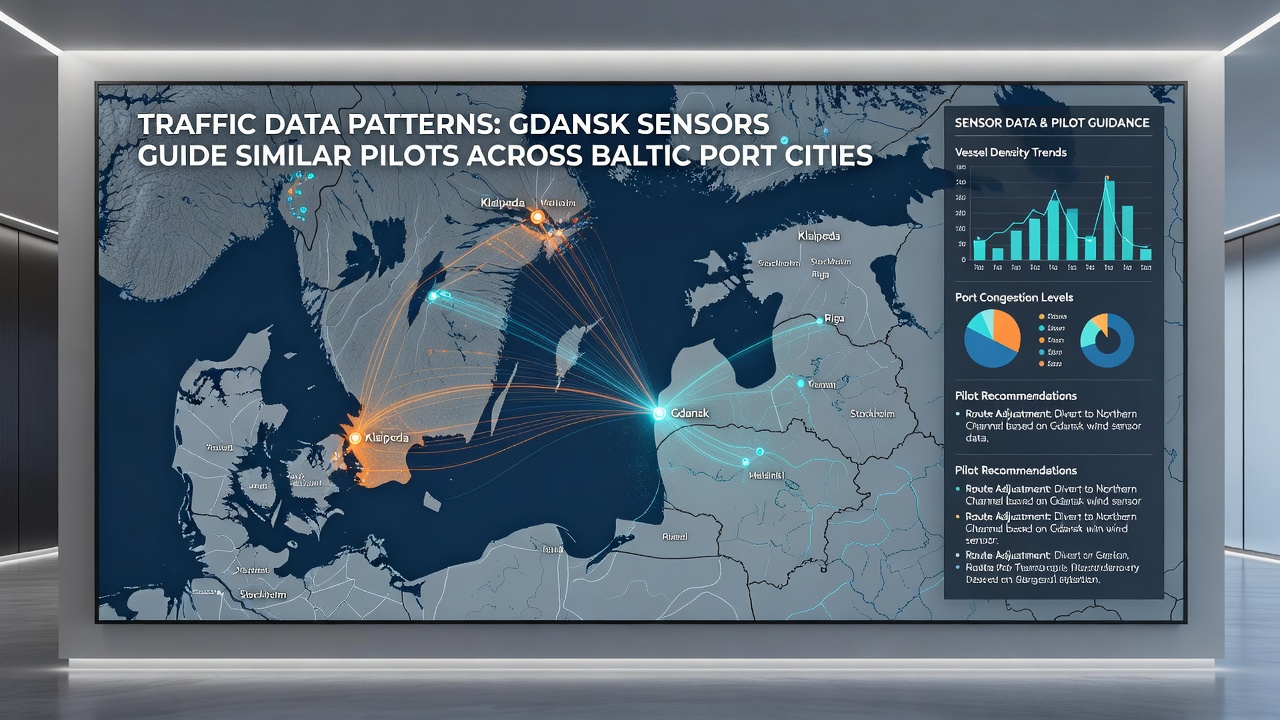
Further analysis highlighted seasonal variations, such as increased ferry traffic during holiday periods that Gdansk sensors tracked through license plate recognition correlations. Those insights prompted Tallinn to test dynamic lane reversals on two approach roads, and preliminary results indicate smoother merging for arriving trucks. Research institutions in the region continue to publish comparative dashboards that allow each city to benchmark its progress against Gdansk baselines.
Key Metrics and Observed Outcomes
Across the pilots, cities report consistent gains in average travel time reliability, with Gdansk recording a 14 percent improvement in on-time freight deliveries after three years of sensor-guided adjustments. Similar figures appear in early Klaipeda evaluations, where adjusted intersection timings cut stop-and-go events by roughly one-fifth. Data also shows reduced variance in queue lengths during peak hours, a metric that port operators track to improve vessel turnaround coordination. According to findings published by the Baltic Ports Organization, these operational efficiencies support broader goals of lowering fuel consumption and meeting regional emissions targets without major infrastructure investments.
Conclusion
Traffic data originating from Gdansk sensors continues to supply a practical reference for Baltic port cities developing their own monitoring networks and pilot interventions. The shared patterns of freight and passenger overlap, combined with documented improvements in flow reliability, provide a foundation for ongoing collaboration. Cities maintain regular data exchanges that allow each location to adapt proven thresholds while accounting for local road geometry and seasonal demands.